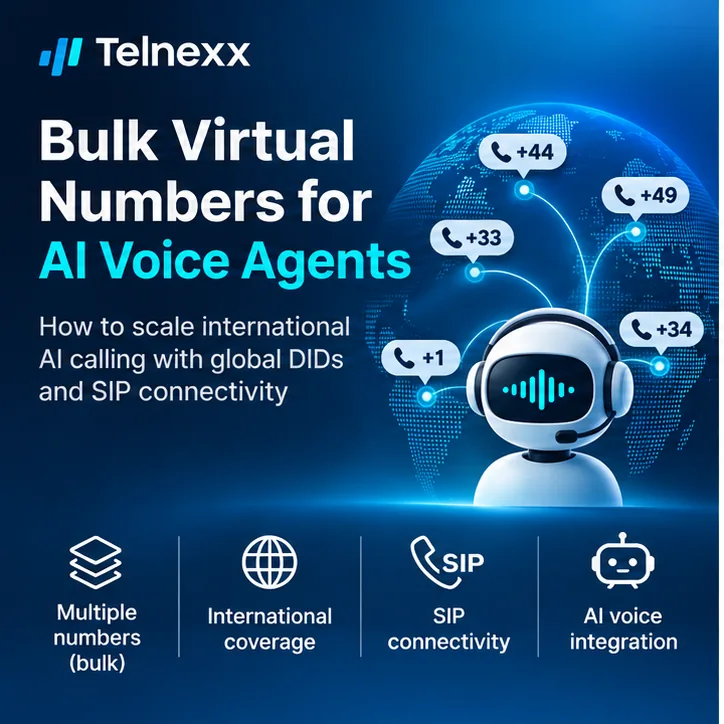
AI voice agents are transforming customer support, lead qualification and appointment scheduling. But scaling them internationally requires more than conversational AI: businesses also need telephone numbers, SIP connectivity and sufficient call capacity.
Why AI voice agents need virtual phone numbers
Virtual phone numbers, also known as DIDs, let customers reach voice applications through familiar local or national telephone numbers. They can support separate numbers for countries, departments, campaigns and customers without a physical phone line at every location.
What are bulk virtual numbers?
Bulk virtual number deployment means planning and obtaining multiple DIDs for a larger project. A rollout might involve dozens or hundreds of numbers, or more where inventory and regulations permit. Requirements should be organized by country, city, number type, use case and expected traffic. Availability, activation timelines and documentation vary by market.
How SIP connects DIDs to AI voice platforms
A typical inbound path is: Customer → Virtual number → SIP routing → Compatible AI voice application. The application handles speech recognition, reasoning and spoken responses. See our virtual numbers for AI voice agents service for a related integration example. Integration with platforms such as Vapi, Retell AI or custom real-time voice systems depends on their supported SIP interfaces, authentication and routing configuration; compatibility must be tested before rollout.
Inbound and outbound calling are different
Inbound numbers do not automatically authorize outbound calls or the use of those numbers as caller IDs. Outbound AI campaigns may require consent, permitted use cases, identity verification and compliance with country-specific rules.
Practical example: one number per AI voice agent
Consider a service company operating in the UK, Germany and Poland. It assigns a local DID to each AI voice agent or business function. An incoming customer call reaches the Telnexx number and is routed via a configured SIP connection to the relevant agent. Depending on the selected AI platform, the agent may capture the inquiry, summarize it for staff or transfer the call to a human operator.
Outbound calls require separate routing, an authorized use case and verified caller ID arrangements. Owning an inbound DID does not automatically grant permission to originate calls displaying that number. For each additional country, check number inventory, documentation, outbound calling rules, concurrent channel capacity and SIP performance. One number per agent is an organizational example, not a technical requirement: more flexible routing may be possible.
Planning a multi-country rollout? Submit a Bulk DID Request with your target countries, estimated number quantities and concurrent call needs. SIP compatibility and both inbound and outbound workflows must be tested with your specific AI platform before production use.
Five considerations for international deployment
- Coverage: identify target countries, cities and number types.
- Registration: confirm business documents, address and local-presence requirements.
- Concurrent calls: size call channels independently of the number of DIDs.
- Routing: test SIP connectivity, failover and call handling.
- Costs: budget for setup, monthly numbers, traffic, channels and AI platform usage.
Use cases for bulk DIDs and AI agents
Common applications include multilingual inbound customer support, regional lead qualification, appointment scheduling, separate numbers for marketing campaigns and telephony infrastructure for AI voice SaaS providers. Privacy, call-recording and consent obligations should be evaluated for each use case.
How Telnexx can help
Telnexx offers AI Voice phone number solutions, international virtual numbers and SIP trunk connectivity. For larger AI voice projects, our team can help evaluate number quantities, target markets, routing needs and concurrent call capacity. Actual availability, commercial terms and activation schedules are confirmed for each request.
Frequently Asked Questions
Can I order hundreds of virtual numbers for AI voice agents?
Large orders can be assessed individually. Available quantities depend on the country, number type, inventory and regulatory requirements. Contact Telnexx with your target markets and estimated quantities for a feasibility check.
Can I connect virtual numbers to my AI voice platform using SIP?
Compatible SIP-based voice platforms can receive calls routed from virtual numbers. Integration depends on the platform’s supported SIP setup and should be tested before production deployment.
Does one virtual number support unlimited simultaneous calls?
No. The number of DIDs and concurrent call capacity are different. Available channels and additional capacity depend on the selected service and commercial configuration.
How much do bulk virtual numbers cost?
Pricing depends on country, number type, setup fees, monthly rental, traffic and any additional channel capacity. Large deployments require an individual quotation.
What documents are needed for international virtual numbers?
Requirements vary by country and number type. Some markets require company registration details, proof of address, local presence or other verification documents.
Plan your bulk number request
To prepare a quotation, specify your target countries and cities, estimated number quantities, number types, inbound or outbound requirements, AI platform, expected concurrent calls, timeline and relevant company documentation.
Planning a multi-country AI voice rollout? Request Bulk DID Pricing to discuss your target countries, estimated number quantities, SIP routing and expected concurrent calls. Quotes and availability are confirmed individually.
Planning an AI voice or SIP integration?
Telnexx can help you choose the number, SIP setup and integration for your business workflow.