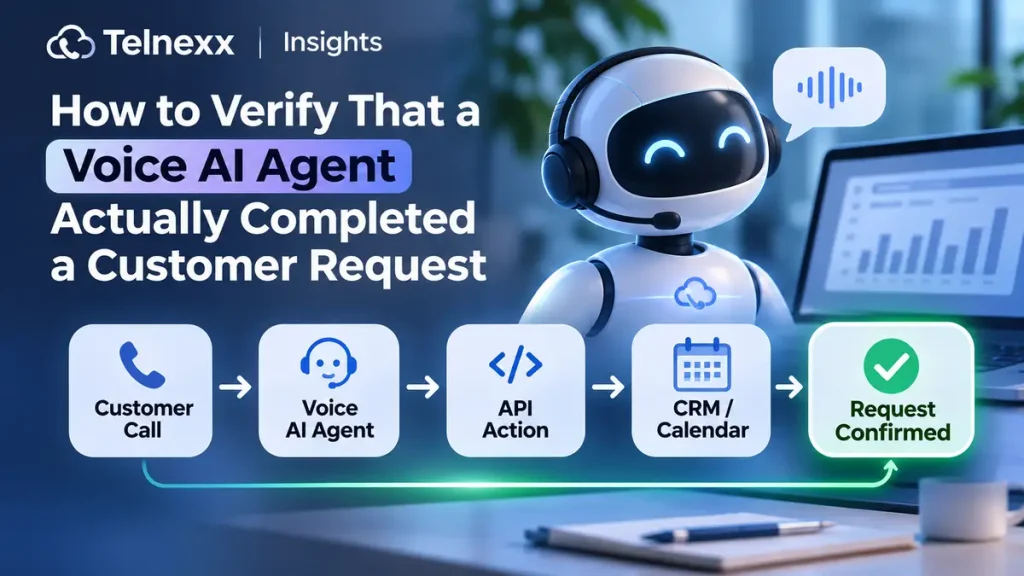
Why a convincing answer is not enough
An AI voice agent might confidently say “Your appointment is confirmed” even though the calendar API failed. Speech recognition and a natural conversation do not establish that a business operation succeeded. What matters is whether the appointment, ticket, or CRM update actually exists. Treat the agent’s words and the external system’s state as separate evidence.
A five-step verification workflow
1. Record the customer’s intent and a call identifier. 2. Send a structured action through an authorized API. 3. Inspect the API response, including errors and the created record ID. 4. Where appropriate, read the record back from the CRM or calendar. 5. Confirm success to the caller only after verification. If verification fails, explain the uncertainty and offer a safe next step.
Example: booking a consultation
A caller requests a consultation at 3 p.m. The agent confirms the date, time zone, and contact details, checks availability, creates an event, and receives its ID. After verifying the saved event, it confirms the booking. If the slot is taken or the calendar returns an error, the agent should offer an alternative rather than claim a booking that does not exist.
What an action log should contain
Useful fields include call ID, timestamp, action type, destination system, execution status, record ID, latency, and verification result. Avoid collecting unnecessary personal information or retaining recordings by default. Restrict access, establish retention periods, and mask sensitive values. Logs should make incidents traceable without creating an uncontrolled archive.
Prevent duplicates and false confirmations
A request can succeed even when its API response is lost. Blind retries can create duplicate tickets or appointments. Use idempotency keys, check for existing records, and limit retries. Distinguish between requested, completed, unverified, and failed states. Escalate sensitive or high-impact actions to a human when needed.
Where telephony fits
Virtual numbers, SIP connectivity, and call routing establish the voice channel; they do not independently prove that a CRM action succeeded. Reliable workflows connect telephony, the voice agent, authorized APIs, and the system of record. Telnexx provides virtual-number and SIP infrastructure that businesses can use as a foundation for their chosen voice integrations. Automation capabilities depend on the connected platform and configuration.
FAQ
Does a call recording prove completion? No. It shows what was said, not whether an external record was saved. Must every action be verified? Prioritize actions with business consequences, such as bookings, orders, payments, and account changes. What if an API fails? Do not claim success; check the final state, offer another route, or hand the request to a human.
Planning an AI voice or SIP integration?
Telnexx can help you choose the number, SIP setup and integration for your business workflow.