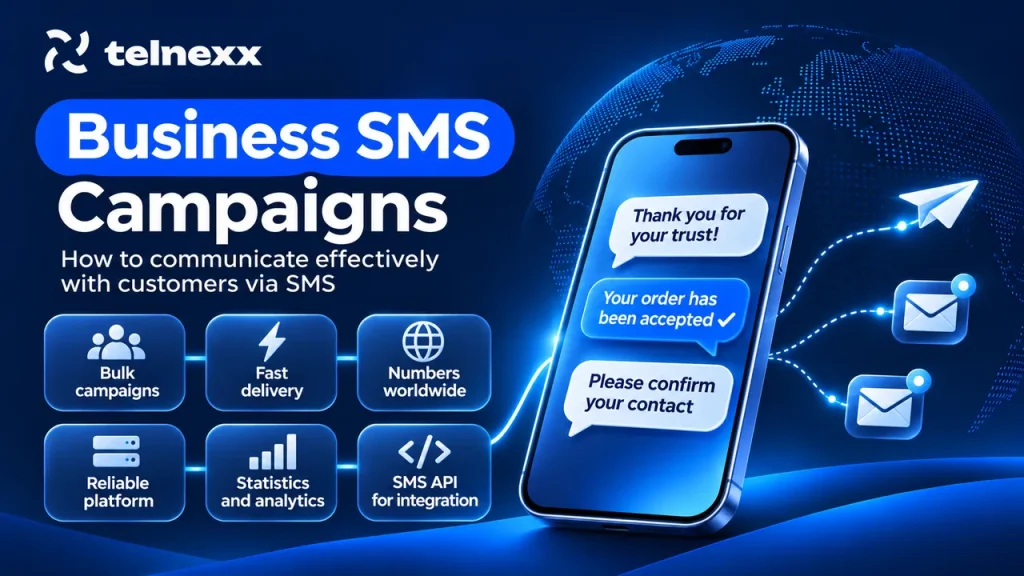
SMS is still useful for concise business communication, including order updates, appointment reminders, service alerts and promotions. But a business SMS campaign involves more than uploading a contact list and pressing Send. You need an appropriate messaging route, permission to use the sender identity, country-specific compliance checks and reliable delivery reporting.
A2P vs P2P: what is the difference?
A2P (application-to-person) messages are generated by business applications and sent to individuals. Typical cases include transactional alerts, one-time passwords, appointment reminders and authorized marketing campaigns. P2P (person-to-person) refers to ordinary communication between individuals. A2P and P2P may have different sender requirements, registration processes, routes and rates.
A virtual number that receives SMS is not automatically a bulk sending solution. Receiving incoming texts by email and distributing outbound campaigns are distinct capabilities.
Where businesses use SMS campaigns
- Transactional notifications: order status, payment updates and operational confirmations.
- Appointment reminders: upcoming consultations, deliveries and bookings.
- Service communications: schedule changes and relevant updates for existing customers.
- Marketing messages: offers and campaigns to appropriately opted-in recipients.
- OTP authentication: one-time codes for logins and sensitive actions. This requires separate security and abuse-prevention considerations; see our OTP verification guide.
How an SMS API fits into your workflow
An SMS API allows a CRM, ecommerce site or business application to submit messages programmatically. A request generally contains the recipient’s phone number, a permitted sender identity and the message text. The messaging platform validates the request, processes it through an available route and returns an identifier. Processing events and delivery receipts may follow asynchronously.
Before sending bulk SMS, normalize phone numbers into an international format, remove duplicates, apply suppression lists and honor unsubscribe requests. API credentials should be protected, rate limits configured and activity logged. Idempotency controls help prevent accidental duplicate messages if a request is retried.
Sender ID registration and country rules
The Sender ID is the phone number or name recipients see. Depending on the destination, it might be a long code, toll-free number, short code or alphanumeric brand name. Some countries and carriers require verification of the business, sender identity, messaging purpose or campaign before A2P traffic can be accepted. For example, US application-to-person SMS sent from 10-digit long code numbers generally requires A2P 10DLC brand and campaign registration.
Reply capability is not universal. For instance, an alphanumeric brand name is typically one-way. If two-way SMS conversations are essential, check the permitted number type and route before choosing the sender.
Consent, opt-outs and responsible messaging
Having a phone number in a customer database does not automatically authorize promotional messages. Requirements differ by country, purpose and customer relationship. For marketing texts, appropriate consent or another specifically applicable legal exception may be required, along with a clear opt-out mechanism. Transactional and marketing communication should not be misleadingly combined.
Keep evidence of how and when permission was obtained. Identify the business clearly, avoid purchased contact lists of uncertain origin and maintain a suppression list for recipients who withdraw permission. Check the local rules for every market you target; this article is a practical overview, not jurisdiction-specific legal advice.
Submitted, sent and delivered are different statuses
An API success response may mean only that the request was accepted. Processing reports describe whether the platform routed the message. A delivery receipt (DLR), when available, records a carrier-reported delivery outcome. An accepted request is therefore not proof of delivery, and a delivered status is not proof that the recipient read the message.
Use unique message IDs to correlate events and make your callback handler tolerant of retries. Track errors such as invalid sender IDs, unavailable routes and expired messages so that campaign metrics reflect actual results rather than just requests sent.
What determines the cost of bulk SMS?
Pricing varies with destination country and carrier, messaging type, sender verification requirements and the number of SMS segments. Character encoding matters: a standard GSM-7 message can fit up to 160 characters in one segment, while a Unicode message commonly fits up to 70. Longer messages may consume multiple billable segments. Special characters, emoji and local-language alphabets can affect the encoding.
A realistic estimate therefore needs the actual destination list, message text and route-specific rates. There is no meaningful universal per-SMS price that applies to every international campaign.
Seven checks before launching a campaign
- Separate transactional, service, OTP and promotional use cases.
- Check the destination countries, networks, available routes and A2P rules.
- Verify or register the sender identity and campaign where required.
- Confirm the contact list is lawful and that opt-outs work.
- Secure your API, add rate limits, idempotency safeguards and logging.
- Estimate charges by destination and segment; send a small controlled test.
- Monitor processing reports and delivery receipts rather than API submissions alone.
Discuss your messaging requirements with Telnexx
Telnexx provides virtual phone numbers, SIP connectivity and business communications solutions. If you are evaluating outbound SMS for a particular country or volume, its availability, API access and commercial terms need to be checked for your intended use case. Bulk outbound campaigns should not be assumed to be included with a virtual number.
Contact Telnexx to discuss your requirements, or explore receiving incoming SMS on a virtual number as a separate service.