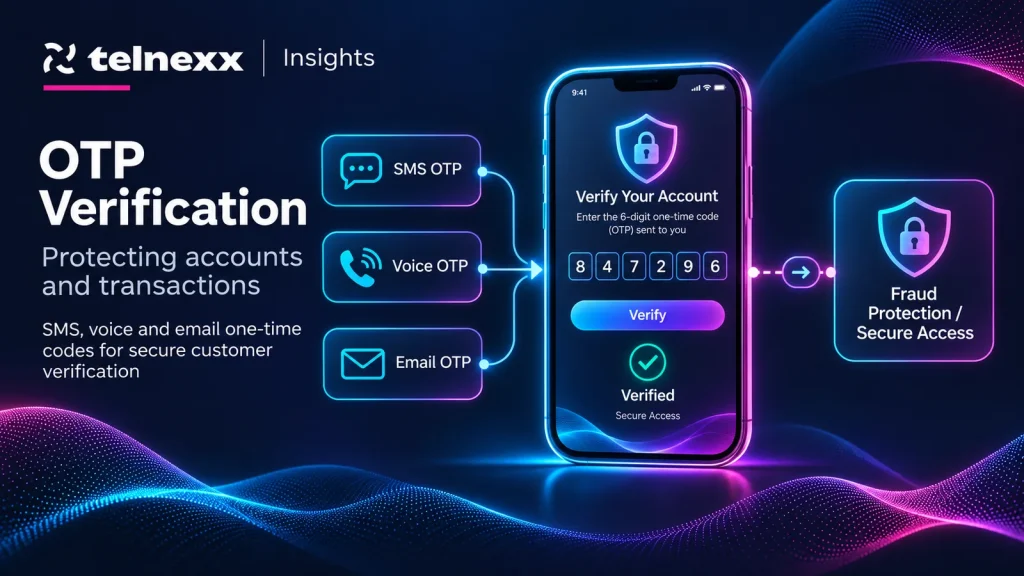
OTP is often treated as a tiny technical step between a login form and account access. For a business, however, it is part of the customer journey: when a code arrives quickly through the right channel, verification feels almost invisible; when delivery is slow, even a sound security flow starts hurting conversion.
That is why a strong OTP flow is more than code generation. It combines security rules, message delivery, fallback channels, resend controls and visibility into where users abandon the process.
Design OTP as part of the customer journey
Users encounter OTP at moments when they already want to complete an important action: sign in from a new device, recover access, confirm a payment, change a phone number or activate a service. Friction at this stage is especially noticeable.
A well-designed flow takes only a few seconds: the system creates a one-time code, sends it through the selected channel, the user enters it, and the backend checks the value, expiry and retry count. Once verification succeeds, the code can no longer be reused.
Code delivery should be treated as a business metric
Teams should not stop at measuring whether a code was generated. What happens after sending matters just as much. Useful metrics include delivery time, successful verification rate, resend frequency, fallback usage and the share of users who leave the flow before completion.
- Delivery latency shows how long users actually wait for the code.
- Verification conversion reveals what share of requests complete successfully.
- Resend rate can expose delivery issues or an overly aggressive timeout.
- Fallback usage shows how often SMS must be replaced by a voice call or another channel.
These are not only security metrics. They directly affect registration, login, account recovery and payment conversion.
Why one delivery channel may not be enough
SMS is convenient as a primary channel, but international products have to account for differences between countries, mobile operators and local delivery rules. Critical flows therefore benefit from a fallback option.
If an SMS does not arrive within the expected window, the user can be offered voice OTP — an automated call that reads the code aloud. Email or push can serve as additional options for lower-risk scenarios.
Security without unnecessary friction
Rules that are too relaxed weaken verification, while rules that are too strict create avoidable drop-off. A practical balance usually comes from several independent controls rather than one hard restriction.
- short code lifetime;
- limited failed attempts;
- resend cooldown;
- rate limits per phone number or account;
- stricter controls for suspicious geographies, devices or abnormal behavior;
- alerting on sudden spikes in OTP requests.
These controls help reduce brute-force attempts, automated abuse and patterns such as SMS pumping.
Where OTP creates the most value
OTP is most useful when it protects higher-risk moments instead of interrupting every routine action.
E-commerce and marketplaces
One-time verification can protect new-device logins, shipping address changes, payment-detail updates and unusually high-value orders.
Financial products
OTP can be used to confirm a new device, sensitive profile changes, a newly added beneficiary or a transaction that falls outside the customer’s normal behavior.
Telecom and SaaS
Verification is useful for service activation, number changes, device onboarding, trial registration and updates to security-sensitive account settings.
A practical pre-launch checklist
- Which countries and mobile networks must be covered?
- Which channel is primary and which one is the fallback?
- How long must a user wait before requesting another code?
- How many failed attempts are allowed before temporary blocking?
- Which delivery and conversion metrics will the team monitor?
- What happens when the primary channel is unavailable?
The Telnexx approach
For an international product, OTP should be treated as part of the communications stack rather than as an isolated login feature. The code and API matter, but so do SMS and voice availability in target markets, route quality, fallback logic and visibility into delivery performance.
Telnexx helps businesses build international voice and messaging scenarios that can support user verification, service notifications and automated communications. A well-designed OTP flow improves security while reducing the number of users who abandon a critical action at the final step.
Planning an AI voice or SIP integration?
Telnexx can help you choose the number, SIP setup and integration for your business workflow.