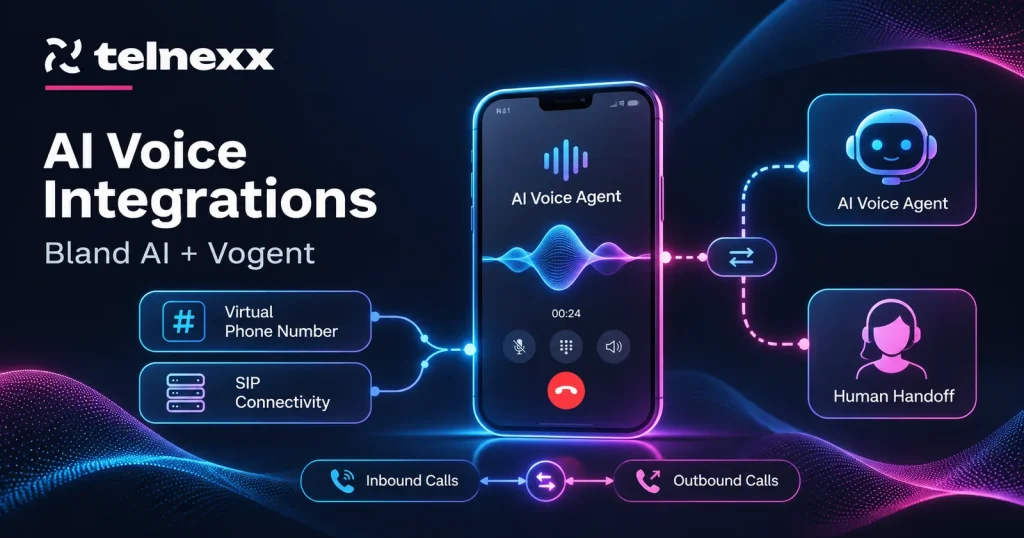
AI voice agents are moving beyond pilot projects into everyday customer communications. For businesses, the challenge is no longer just how naturally an agent speaks. It is also how to connect that agent to a real telephone number, handle inbound and outbound calls, and transfer a conversation to a human colleague when needed.
Telnexx supports SIP-based integration scenarios with Bland AI and Vogent. Businesses can combine a virtual phone number, SIP connectivity, an AI voice agent and human handoff into one workflow. In standard configurations, this can be done without deploying a custom media gateway.
What businesses can do with AI voice integrations
A Telnexx number can serve as the entry point for an AI receptionist, first-line support, lead qualification or automated outbound calling. The agent answers routine questions, collects information and routes conversations to the right person according to defined rules.
- Receive inbound calls on a conventional telephone number and route them to an AI agent.
- Support outbound AI calling through a suitable SIP configuration.
- Apply routing rules by country, department or customer scenario.
- Transfer complex or sensitive conversations to a human agent.
- Scale numbers and concurrent call capacity as demand grows.
Bland AI: SIP connectivity and agent handoff
Bland AI supports voice-agent workflows for both inbound and outbound calls. Depending on the supported configuration, SIP connectivity can use TLS on port 5061 and encrypted media with SRTP SDES. Regional SIP endpoints can help select an appropriate connection path.
Human escalation can be handled through SIP REFER in supported call flows. For example, an AI assistant may confirm a customer’s request, gather an order number and then route the caller to the relevant department. Transfer behaviour should be tested against the chosen SIP and agent setup.
Vogent: warm transfers that preserve context
Vogent can also be connected to a Telnexx telephony configuration for inbound and outbound AI voice scenarios. One particularly useful capability is warm transfer: before connecting the caller, the AI agent can brief the human representative on who is calling and why.
This reduces the need for customers to repeat their questions after a transfer. In sales and support environments, it allows automation to function as part of the broader customer service process rather than as a separate chatbot.
A warm transfer may introduce an additional outbound call leg. Businesses should account for the corresponding call charges when estimating the cost per interaction.
A practical Telnexx solution
A typical deployment brings together a Telnexx virtual number, SIP routing and an AI platform selected for the business workflow. Teams can then configure one or more use cases:
- AI receptionist: answers common questions and directs callers to the right team.
- AI sales assistant: screens new enquiries before handing qualified leads to a manager.
- AI support: collects initial details and escalates issues that require a specialist.
- Outbound AI: handles selected reminders, confirmations and surveys, subject to applicable calling and consent rules.
Why the architecture matters
An effective voice-AI rollout depends on more than the language model. Telephone number coverage, SIP routing, call concurrency, media security, outbound calling and reliable transfers all affect the experience. Bringing these elements together makes it easier to test an AI workflow without building a telecommunications platform from scratch.
For many teams, the sensible starting point is a narrow scenario with clear success metrics and an explicit path to a human operator. The configuration can then be expanded as call quality and customer outcomes are validated.
Want to connect an AI agent to a phone number?
Telnexx can help you select a virtual phone number, plan the SIP connection and assess an integration approach for Bland AI or Vogent. We can help align inbound and outbound call scenarios, routing and human handoff with your operational requirements.