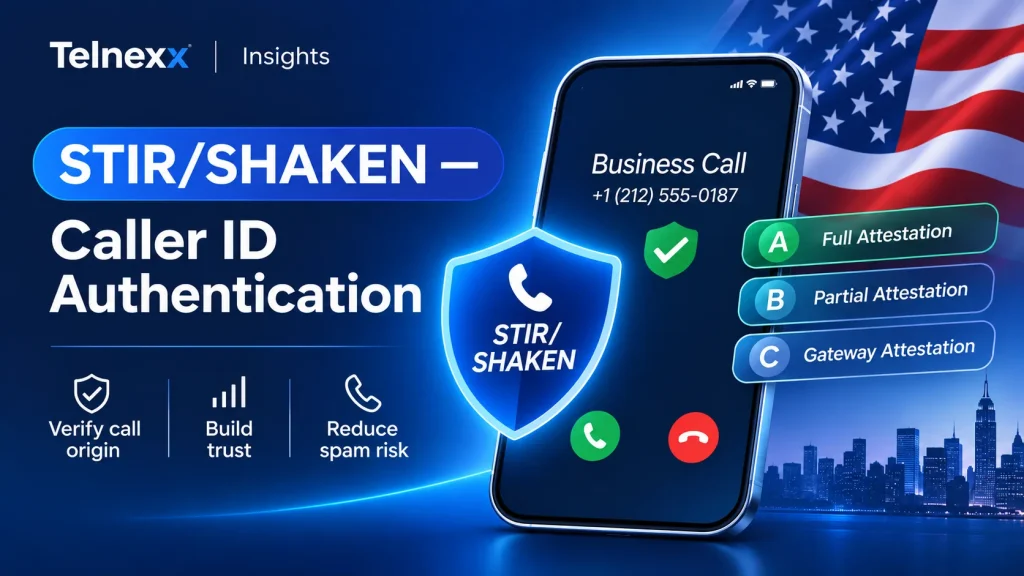
A legitimate business call to a US customer may display Spam Risk or Scam Likely. STIR/SHAKEN is one mechanism designed to reduce caller ID spoofing, but authentication is only one part of call trust.
What is STIR/SHAKEN?
STIR (Secure Telephone Identity Revisited) and SHAKEN (Signature-based Handling of Asserted information using toKENs) are complementary caller ID authentication standards. In compatible IP networks, a provider can digitally sign calling information and the receiving provider can verify that signature.
STIR/SHAKEN does not inspect the conversation or guarantee that a caller is legitimate. It helps establish confidence in the calling number information.
Attestation levels A, B and C
- A — Full Attestation: the originating provider authenticated the customer and verified their right to use the calling number.
- B — Partial Attestation: the provider knows the customer but cannot fully verify their right to use the specific number.
- C — Gateway Attestation: the provider identifies the point where the call entered its network without verifying the original caller or their right to the number.
A provides the highest assurance in this framework. B or C does not automatically indicate fraud.
Why do legitimate calls still get spam labels?
Carriers and analytics services may consider call frequency, complaints, number reputation, short or unanswered calls, and unusual calling patterns alongside authentication results. Full attestation does not guarantee delivery without spam labeling.
What changed in November 2026?
On November 5, 2026, Twilio announced STIR/SHAKEN status in the Voice API Call resource through the stir_verstat property. This illustrates how authentication information can become available for application-level analytics. A feature offered by one provider is not automatically available on other platforms.
Five practical steps for businesses
- Use caller IDs your organization is authorized to present.
- Ask your voice provider whether STIR/SHAKEN is supported, who signs calls, and whether attestation data is exposed.
- Respect applicable consent rules and avoid excessive or misleading calling patterns.
- Monitor failures, blocks, complaints, and spam labels.
- Investigate number reputation issues and use appropriate business-number registration or remediation channels.
Business voice infrastructure with Telnexx
Telnexx provides virtual phone numbers and SIP connectivity for business communications. For outbound calling to the United States, organizations should evaluate caller ID requirements, routing, regulatory obligations, and authentication alongside connectivity and pricing. STIR/SHAKEN support and access to attestation data depend on the specific route and technical setup.
Planning calls to US customers? Contact Telnexx to discuss number options, SIP connectivity, and your calling workflow.
Sources
- Twilio Changelog, November 5, 2026 — Voice API Call resource STIR/SHAKEN status.
- FCC — STIR/SHAKEN caller ID authentication guidance.
Planning an AI voice or SIP integration?
Telnexx can help you choose the number, SIP setup and integration for your business workflow.